
Biology Becomes Programming
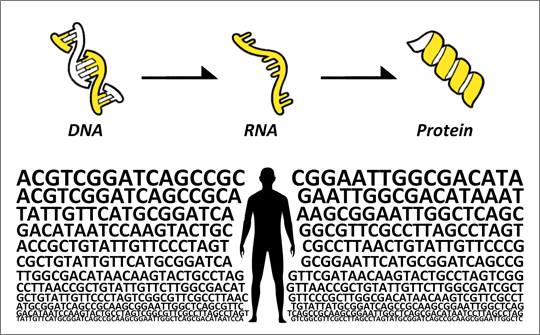

Imagine the hypothetical scenario in which humans found thousands of computers falling from the sky around 20,000 years ago. For the sake of discussion, imagine that the computers are self powered. In many ways, this is comparable to examining a new lifeform, as they find these silicon creatures that appear to think and operate on their own. These early humans may begin trying to eat them, hit them, anything to provoke a response and better understand these strange “organisms” they have discovered. This level of experimentation and observation would continue for centuries as the humans take slow steps towards understanding these mysterious machines.
Eventually, these proto-scientists develop a more functional understanding of computers and data storage. They name parts of the computers with labels such as CPU, RAM, and HDD and notice that there is some information flowing through bits (0s and 1s) among these components to carry out computations. Also, thunderstorms might provide insight into the connections between the binary code and the computers’ software program features and functions shown on monitors. For instance, one bit change (e.g., 0 to 1) could lead to the software incorrectly displaying some text or rendering the mouse unusable. In our imagined scenario, the ancient humans realize that computers are capable of understanding binary code, and people attempt to write simple programs using this machine language. This binary code (perhaps, billions of 0s and 1s) turns out to be too much and too complicated for people to efficiently understand and modify. The aspiring programmers then begin to consider a method for simplifying the machine coding interface.
This hypothetical scenario mirrors when advanced programming languages such as C++ began to be developed in real life, and the breakthroughs were world-shaping. It is incredible to consider how much computer science has changed the world over the past century, giving rise to innovations such as the internet, Windows/iOS operating systems, and other key advancements that have ushered humanity into an unprecedented era of connectivity and technological growth.
Similarly in real life, around the 1600s people began to observe microorganisms. Considering the significant changes the world has undergone as a direct result of discoveries in computer science, it is very exciting to consider how biology might follow the same trajectory of changing the world. This discovery of microorganisms was in many ways just as jarring as our hypothetical ancient people discovering computers. These antiquarian biologists began running experiments and making observations about lifeforms. As their understanding deepened, they noticed a consistent code for life, which we now called DNA. We analyzed this novel molecule and uncovered its structure and functions. We now have a more advanced understanding of DNA, how it replicates, how it is transcribed into RNA, and how that RNA is eventually translated into the proteins that make up an organism. Much like machine code, it can be difficult to manipulate DNA in a way that can lead to much innovation. We have developed some simple methods of DNA manipulation such as molecular cloning, or CRISPR technology, but we still lack a simplified method of describing life. In the same way that C++ and other high-level programming languages were developed to describe machine code more efficiently, Univeristy of Texas Southwestern Medical Center* and Omphalos Lifesciences are developing a new programming language, L++, that can act as the first high-level programming language to efficiently describe lifeforms as an alternative to DNA.
These stark similarities between the advancement of computer science and biology signal that we are on the precipice of another era of rapid world change. Everyone can see what the creation of languages such as C++ has done for the world—computers have become an integral part of each of our lives. As we harness the capacity for efficient DNA programming via L++, we anticipate revolutionary change in the world at an even larger scale than that resulting from efficient machine language programming via high-level languages.
No doubt, we are living in exciting times for the field of biotechnology. With languages and tools such as L++ on the horizon, the possible biological innovations are breathtaking to consider. In the same way that computers and programming have revolutionized our lives, lifeform programming will propel the world into a new era of innovation with advancements that were previously thought to be confined to science fiction. Indeed, it appears there is a bright future for humanity with the impending discoveries in biotechnology. We hope that you will join us in our journey of pioneering the merging of biology and programming, as we are overjoyed to share the exciting steps we are taking to create a more beautiful world.
In future blogs, we are excited to share many of these areas of innovation, so please stay connected with us!
* The Kim Lab in the Lyda Hill Department of Bioinformatics at The Univeristy of Texas Southwestern Medical Center and Omphalos Lifesciences Inc are developing a new programming language, L++.


0 Comments