

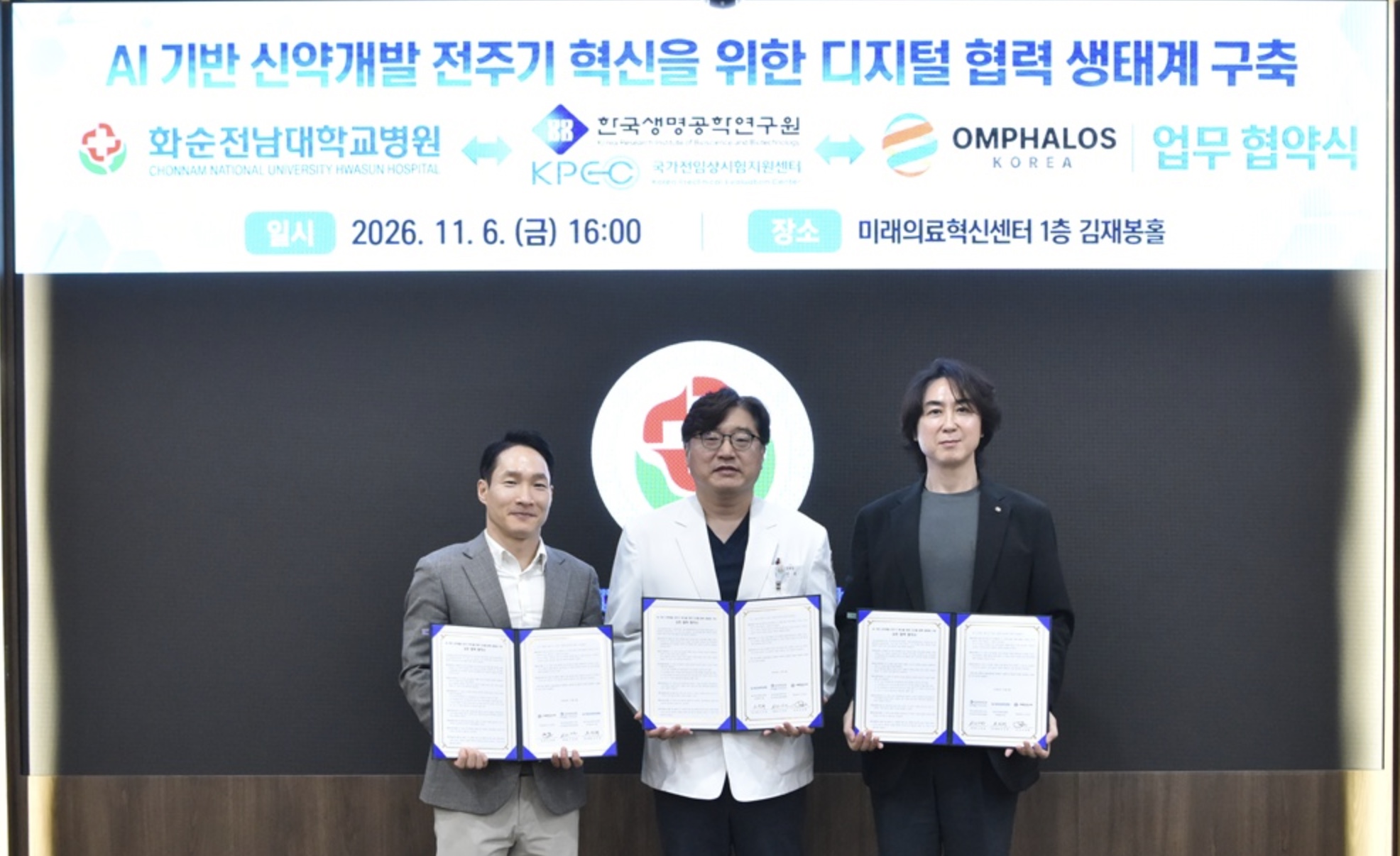
Omphalos partners with Hwasun Chonnam National University Hospital on AI drug development
Nov 2026
An agreement with KRIBB's Korea Preclinical Evaluation Center and Omphalos Korea
Joint research on digital preclinical work and AI virtual cells
Hwasun Chonnam National University Hospital is taking up AI-assisted drug development together with the Korea Preclinical Evaluation Center (KPEC) at the Korea Research Institute of Bioscience and Biotechnology (KRIBB) and Omphalos Korea. The three institutions will research digital preclinical work and AI virtual cells together, and identify joint projects that carry preclinical research through to the clinic.

The hospital said on November 11 that its Biomedical Research Institute had signed the agreement with KPEC and Omphalos Korea at Kim Jae-bong Hall in the hospital's Future Medical Innovation Center.
The three will link each institution's research data and digital platforms through the K-HOPE project group, and on that basis plan the projects that preclinical and clinical researchers will carry out together in drug development.
At a seminar held before the signing by the K-HOPE project group, KPEC director Kyungchul Ko introduced the center's role and Omphalos Korea CEO Daehwan Kim explained digital cell technology. OncoCross CEO Yirang Kim presented the state of AI drug development, and Professor Hyunsoo Jung of the Gwangju Institute of Science and Technology (GIST) presented research trends in genomics, single-cell analysis, and aging.
Injae Oh, director of the Biomedical Research Institute at Hwasun Chonnam National University Hospital, said the partners would "combine each organization's expertise and research infrastructure to make joint research more active, and raise the competitiveness of AI-based drug development and precision medicine research."
Source: Medical Times, reported by Hansoo Lee
← Back to News