






Biological system modeling at scale

The core technologies behind our models and how researchers work with AI.

—The stack

Research platform, biological language, and model library

product

LIFABRICA

The hosted, conversational way to reach every model Omphalos and its community build. Ask a question, get a simulation-backed answer, and run experiments without writing code.

foundation

L++

The biology-native language and simulation engine LIFABRICA runs on. Learnable by a biologist in under a day, with native syntax for chemistry, units, space, and time.

commons

Life Code

An open, community-governed library of models and data that LIFABRICA draws on, stewarded by the independent Life Code Foundation. Contributors are credited and compensated for what they add.

—Method

How a model gets built

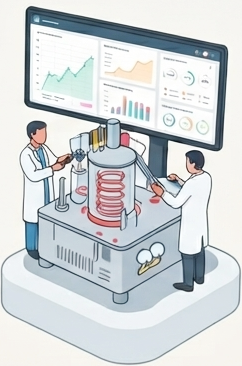
AI builds models, runs simulations, and analyzes results. Researchers guide the work and evaluate the science.

  1. 01

    Draft

    Generative AI assembles model components (reaction networks, parameter sets, compartmental structure) from literature and existing open-source models.

  2. 02

    Inspect

    A domain expert reviews the logic, assumptions, and parameters directly in L++ before anything is accepted. This is genuine authorship.

  3. 03

    Simulate

    The model runs. Plausible-sounding but structurally wrong reactions tend to surface here, visible in the output.

  4. 04

    Calibrate & validate

    The model is tested against experimental or omics data it was never fitted to, and revised.

  5. 05

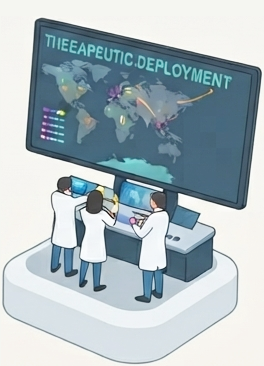
    Deploy

    The validated model becomes reusable infrastructure: ported, extended, or deployed into a new application.

—Flagship models

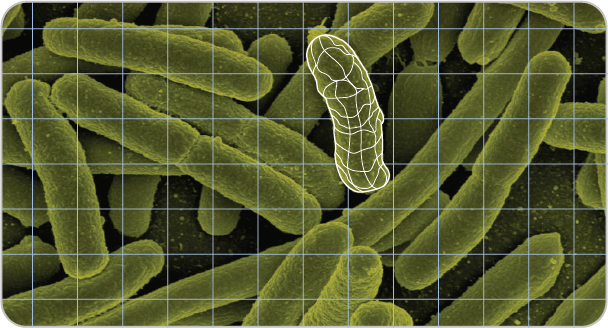
Virtual E. coli

Standard laboratory strains for molecular cloning and protein expression
What it demonstrates

Escherichia coli, the standard laboratory bacterium. One integrated kinetic simulation, built first-principles from biochemistry and enzyme kinetics: ~40,000 reactions/processes, 4,403 genes expressed genome-wide. Reproduces known experimental results and sustains many clean doublings in live runs.
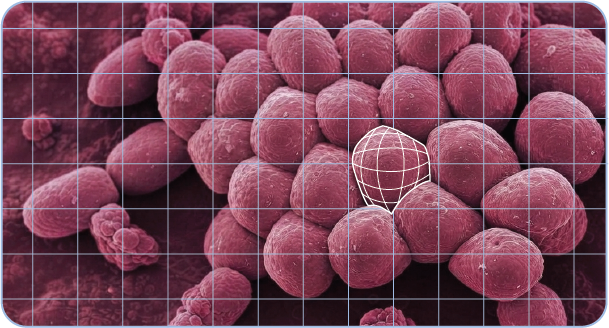
Virtual A. baumannii

Drug-susceptible + multi-drug resistant
What it demonstrates

Acinetobacter baumannii, a drug-resistant hospital pathogen. Derived from the E. coli reference; simulated doubling time closely matches published values. Antibiotic response matches known patterns: effective on the drug-susceptible strain, resistant in the multi-drug-resistant strain, with combination therapy still suppressing its growth.

Virtual CHO cell

Early draft
What it demonstrates

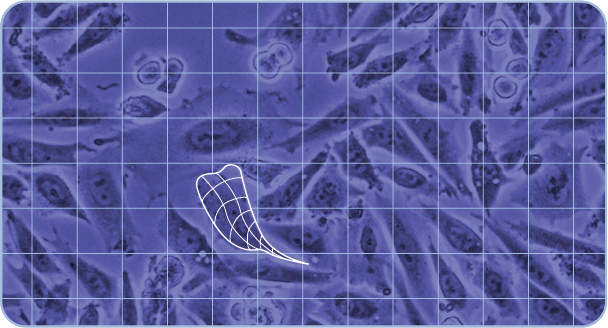
A Chinese hamster ovary cell model for biomanufacturing advanced therapeutics, from antibodies to cell and gene therapies. An early draft, not yet validated, that we'll advance together with the community.

Virtual human cell

Early draft
What it demonstrates

A comprehensive cellular model of a human cell, built on the same kinetic engine as the microbial models. An early draft, not yet validated, that we'll advance together with the community.

Multiscale virtual human

Early draft
What it demonstrates

Extends the virtual cell to whole-body scale for integrated PK/PD and ADME-Tox simulation. An early draft, not yet validated, that we'll advance together with the community.

—Applications

From medicine to industry

A sample: the same platform extends to other domains that reduce to biological simulation.

Drug development

Testing a candidate drug or dosing strategy in simulation before it reaches the bench, across disease areas such as antimicrobial resistance, viral infection, cancer, immune-related conditions, and neurodegenerative disease.

Virtual clinical trials

Simulating trial populations and dosing arms to evaluate a candidate's likely response before running a real trial.

Bioproduction & process engineering

Designing and scaling up industrial cell strains (in silico, before the bench) to cut trial-and-error out of biomanufacturing.

Agriculture & crop engineering

Modeling crop and microbial traits to guide breeding and engineering decisions before the field trial.

Personalized medicine

Using an individual's own genome and health data with a whole-body model to tailor diagnosis and treatment.

Education

Teaching mechanistic modeling to researchers with no coding or modeling background, through hands-on workshops.