
Life in light of atoms, molecules, and proteins
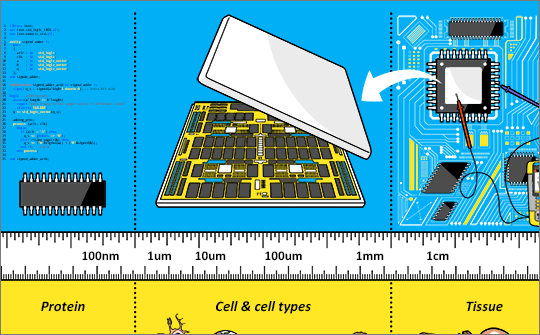
What we now call Biology used to be considered “magic”. Before Germ Theory, developed in the mid-nineteenth century, diseases were often associated with demons and other malicious creatures of myth. Take tuberculosis for example, the disease that gave rise to the myth of the vampire. The more we have learned about life the further Biology has separated from mystical practices, so let’s break life down to its basics and evaluate the organization behind Life’s structure.

The electronics we build share a similar logical construction to the organization of life.
The computers we build are designed to come together in a hierarchical fashion. At their core conductive materials are built around a silicon base for silicon’s insulative properties. These materials are used to construct transistors which we use to develop the semiconductors that will control the flow of electrical currents in a CPU: the computer’s brain that processes all of the information passing through it. The CPU works in tandem with other components, such as video cards and RAM, that are all connected by their attachments to a motherboard: the central circuit of the computer. To protect the computer from damage, these components are kept within a hard plastic case. This organization that we use to build a computer up from atoms is not new, the construction of life follows a similar logic.
The uniqueness of atoms and how they are used to construct life has been a focus for scientists of all trades for centuries and their properties have allowed for a world teeming with fascinating molecules. Several classes of molecules, carbohydrates, lipids, nucleic acids, and proteins collaborate to construct the smallest unit of life: the cell. As the organization and molecular content of cells differ, similar and specialized cells will self-sort in the larger population to form tissues that will cooperate throughout the body. Thus cooperation amongst tissues is used to construct organs that are interconnected as organ systems, all encapsulated by protective membranes and tissues to build the organism.
The technology we have used to learn about the molecular workings behind biological systems has been rapidly evolving, allowing us to more readily expand our understanding of life’s components and the characteristics of molecules and their interactions that make each an essential part of life. The breadth of unsolved mysteries in life may make it seem like we have only just started to scratch the surface of the molecular world; however, with a finite number of molecules for nature to use in its designs we continually find both individual molecules and families of molecules reiterating in many biological pathways. With our current understanding of the molecular foundations of life, it is not a Sisyphean task to begin modeling life or giving a virtual form to extant, extinct, or imagined life in a virtual environment.
The hierarchical structure of a computer mirrors that of living organisms, and soon we will be bridging the gap between computer and creature. In our last blog post: Transcending Time, Space, and Resources via Life Virtualization we discussed how scientists will be able to perform in silico experiments by using L++ to design and code organisms in a language that computers can use to accurately generate virtual life that behaves molecularly and cellularly like a living organism. Virtual life models designed by L++ will be built using the same logical construction that supports life, allowing users to navigate the scaffolding of life at resolutions from single molecules to whole organisms.


0 Comments